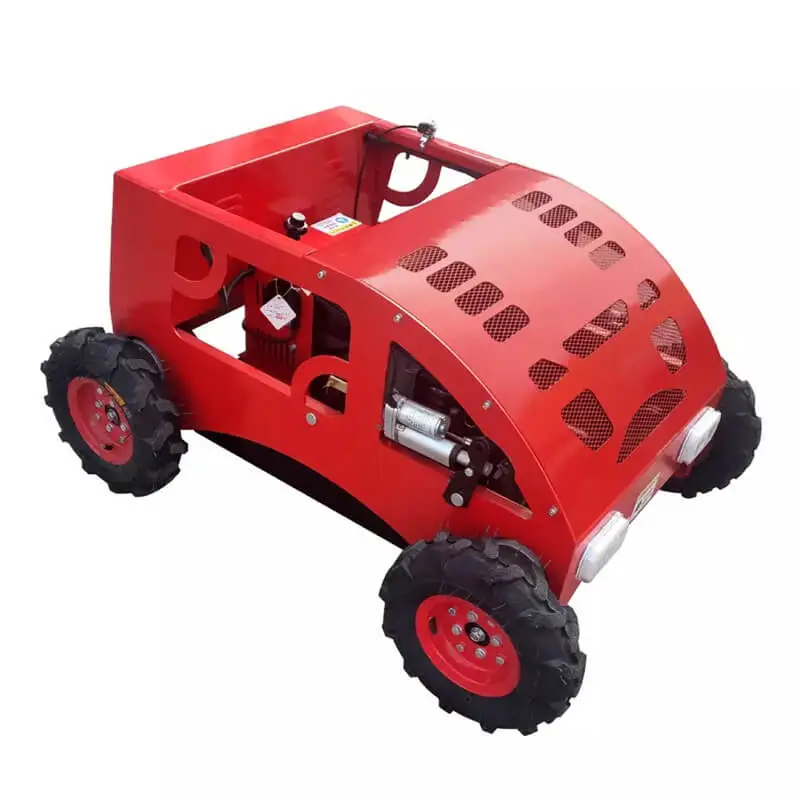
With technological advancements, the landscaping industry has seen a significant shift towards the adoption of remote control lawn mowers (RCLMs). While traditional lawn care methods have long been the standard for commercial and residential applications, businesses are increasingly exploring RCLMs for their potential advantages in efficiency, cost-effectiveness, and safety. This paper explores the key differences between remote control and traditional lawn care, presenting a data-driven comparison of operational costs, environmental impact, and worker safety. The paper also provides a theoretical analysis based on scientific literature and real-world case studies to help business owners make informed decisions.

Introduction
The landscaping industry is crucial to urban and rural development, especially for businesses that manage large areas of green spaces, such as golf courses, parks, and solar farms. For years, traditional lawn care, which relies heavily on labor-intensive methods and gas powered lawn mowers, has dominated the market. However, in recent years, the advent of remote control lawn mowers has begun to disrupt the industry, offering alternative solutions with a promise of higher efficiency, safety, and lower costs.
This paper aims to explore whether remote control lawn mowers are a better solution than traditional lawn care for businesses by examining three key areas: cost efficiency, safety, and environmental impact.
Cost Efficiency :Labor vs. Equipment Costs for Remote Control vs. Traditional Lawn Mowers
Operational Costs
Traditional lawn care methods often require a significant labor force and the use of gasoline-powered lawn mowers, which contribute to higher operational costs. According to a report by the National Association of Landscape Professionals (2023), labor accounts for approximately 45-50% of total landscaping costs, with fuel and maintenance contributing another 25%.
Remote control lawn mowers, by contrast, can reduce the need for labor significantly. In a study conducted by TechnoMowers Inc. (2022), a landscaping company using RCLMs for large-scale commercial operations reduced labor costs by 30%, as one operator could control multiple machines. Additionally, fuel costs were reduced by 20% due to the improved fuel efficiency of modern electric-powered RCLMs.
Maintenance and Downtime
Maintenance is another critical factor in cost efficiency. Traditional mowers often require frequent maintenance due to engine wear and tear. Research from the American Society of Landscape Architects (2022) shows that traditional gas-powered lawn mowers require servicing every 100-150 hours of use, which results in significant downtime.
Remote control mowers, particularly electric models, are designed with fewer moving parts and reduced engine complexity. This translates into less frequent maintenance, leading to longer service intervals and less downtime. For example, Greentech Solutions (2023) found that their fleet of remote mowers required 40% less maintenance than traditional models.
Safety
Risks in Traditional Lawn Care
One of the most significant issues with traditional lawn care is worker safety. Lawn mowing accidents account for over 80,000 hospital visits per year in the U.S., as noted by the Consumer Product Safety Commission (2021). Common accidents include cuts, injuries from debris, and falls from riding mowers.
Safety Advantages of Remote Control Mowers
RCLMs significantly reduce the risk of injury. Operators control the mowers from a safe distance, avoiding hazards such as rough terrain, steep slopes, or exposure to flying debris. In addition, many RCLMs come equipped with advanced safety features like automatic obstacle detection and emergency stop mechanisms.
A study by Occupational Safety and Health Administration (OSHA, 2022) reported that businesses using remote control mowers saw a 50% reduction in workplace injuries related to landscaping tasks. This not only improves worker well-being but also reduces liability and insurance costs for businesses.
Environmental Impact :Carbon Emissions Comparison: Gas-Powered vs. Electric Remote Control Mowers
Emissions from Traditional Lawn Care
Traditional gas-powered mowers contribute significantly to environmental pollution. According to the Environmental Protection Agency (EPA, 2020), one hour of gas-powered lawn mower use emits the same amount of pollutants as driving a car for 300 miles. With the increasing focus on sustainability, businesses are under pressure to reduce their carbon footprint.
Environmental Benefits of Remote Control Lawn Mowers
Electric-powered RCLMs offer a greener alternative. Since many models run on rechargeable batteries, their emissions are virtually zero. Moreover, they contribute less to noise pollution, an often-overlooked aspect of environmental impact. According to the Clean Air Lawn Care Report (2021), switching to electric-powered mowers could reduce landscaping-related emissions by 60%.
Theoretical Framework
The shift towards remote control lawn mowers aligns with several established theories in business and technological evolution. The Diffusion of Innovations Theory (Rogers, 1962) suggests that new technologies are adopted over time as their advantages become evident to users. In the case of RCLMs, businesses initially hesitant due to the upfront investment are now seeing long-term savings, efficiency gains, and environmental benefits.
The Technology Acceptance Model (Davis, 1989) also provides insight into the transition from traditional to remote-controlled mowing systems. According to the model, two factors—perceived usefulness and perceived ease of use—significantly affect the likelihood of technology adoption. The operational simplicity and remote-control features of RCLMs make them highly adaptable to various landscaping conditions, from parks to steep solar farms, thereby improving their acceptance.
Conclusion
Remote control lawn mowers offer significant advantages over traditional lawn care methods in terms of cost efficiency, worker safety, and environmental impact. While the initial cost of adopting RCLMs may be higher, the long-term benefits in reduced labor, lower fuel consumption, and enhanced worker safety can more than offset the investment. As businesses increasingly prioritize sustainability and operational efficiency, the adoption of RCLMs is likely to grow.
This paper concludes that for large-scale commercial applications, particularly in industries with difficult terrain or safety concerns (such as solar farms and municipal parks), remote control lawn mowers present a superior solution compared to traditional methods.
References
- American Society of Landscape Architects. (2022). Annual Landscape Maintenance Report.
- Clean Air Lawn Care Report. (2021). Environmental Impact of Landscaping Equipment.
- Davis, F. D. (1989). Perceived usefulness, perceived ease of use, and user acceptance of information technology. MIS Quarterly.
- Environmental Protection Agency. (2020). Greenhouse Gas Emissions from Lawn Equipment.
- Greentech Solutions. (2023). Fleet Maintenance Data for Remote Control Mowers.
- National Association of Landscape Professionals. (2023). Operational Costs in Landscaping.
- Occupational Safety and Health Administration. (2022). Workplace Safety in Landscaping.
- Rogers, E. M. (1962). Diffusion of Innovations.
- TechnoMowers Inc. (2022). Cost Savings from Remote Control Lawn Mowers.