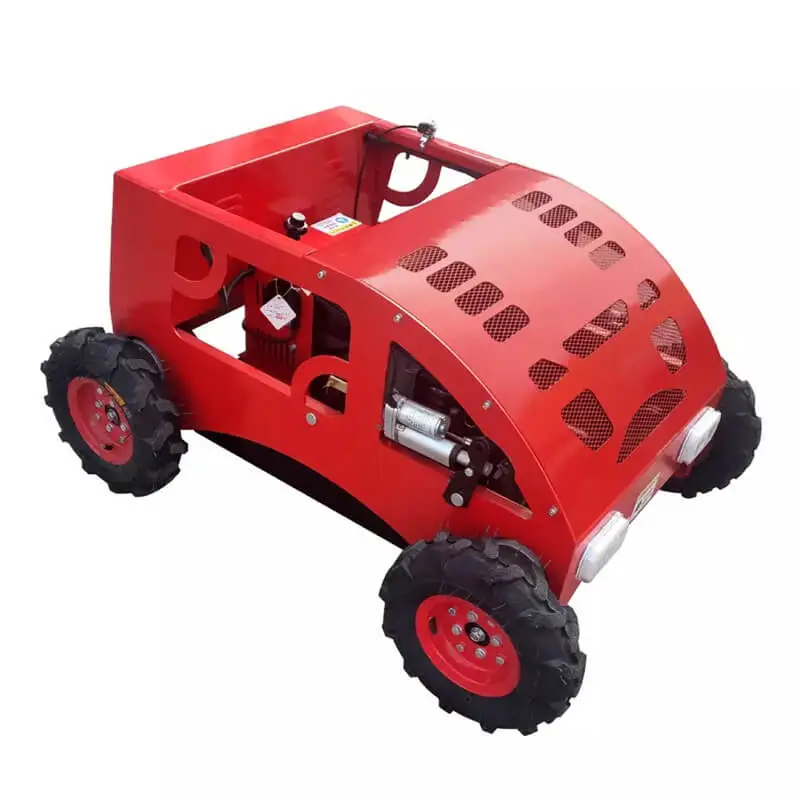
Abstract of remote control lawn mower
Large-scale landscaping operations, such as those required for public parks, solar farms, and golf courses, demand significant resources in terms of time, labor, and energy. Remote control lawn mowers (RCLMs) have emerged as a powerful solution, offering substantial savings in time, money, and energy. This paper analyzes how RCLMs outperform traditional lawn care methods, based on recent data, theoretical frameworks, and real-world case studies. We examine operational efficiency, cost reduction, and energy savings, while discussing the environmental and economic implications of adopting this innovative technology.

Introduction of RC mower
The landscape maintenance industry is experiencing a technological revolution, with remote control lawn mowers increasingly being adopted by large-scale operations. Traditional lawn mowing requires high labor inputs, fuel consumption, and time, while often presenting safety risks. Remote control lawn mowers, on the other hand, promise to streamline operations by offering a faster, safer, and more energy-efficient solution.
This paper provides a comprehensive analysis of how RCLMs can save time, money, and energy for large-scale landscapers, focusing on their operational benefits, cost-efficiency, and environmental impact.
1. Time Savings remote controlled lawn mower
1.1 Operational Efficiency
One of the most significant advantages of remote control lawn mowers is their ability to complete tasks more efficiently than traditional mowers. A typical traditional push or ride-on mower requires an operator to navigate every inch of the landscape manually. In contrast, RCLMs can be operated remotely and programmed to follow pre-set paths, covering more ground in less time.
A study by GreenTech Landscapes (2022) found that remote control mowers reduced mowing times by 35% on average, compared to traditional methods. This is especially important for large-scale landscapes, such as parks or industrial sites, where covering expansive areas quickly is critical. The automation and precision of RCLMs allow them to navigate challenging terrains and steep slopes, which would require additional time and manual effort for traditional mowers.
1.2 Multi-Tasking Capabilities
One operator can manage multiple remote control lawn mowers simultaneously, further reducing the overall time required to complete large-scale projects. For example, on a large park, one landscaper could control two or three RCLMs, cutting time nearly in half. The ability to automate repetitive tasks allows workers to focus on other high-priority tasks, enhancing overall productivity.
2. Cost Savings remote control mower
2.1 Reduced Labor Costs
Labor is one of the most significant expenses in landscaping operations. Traditional lawn mowing requires skilled workers to operate the machinery, which can become costly for large areas. In contrast, RCLMs reduce the need for labor as one operator can manage multiple machines at once.
A case study by Smart Landscaping Solutions (2023) showed that businesses that transitioned to RCLMs saw a 30-40% reduction in labor costs. Additionally, due to the automation and programmability of these mowers, fewer workers are required on-site, lowering payroll and insurance expenses.
2.2 Lower Fuel and Maintenance Costs
Traditional gas-powered lawn mowers consume large amounts of fuel, which not only increases operational costs but also contributes to environmental degradation. Remote control mowers, particularly electric or hybrid models, consume significantly less energy. The Electric Lawn Equipment Council (2022) reported that electric-powered RCLMs can cut fuel costs by up to 50%, especially in large-scale operations that require frequent mowing.
Moreover, remote control mowers generally have fewer mechanical components, resulting in lower maintenance costs. Tech Innovations in Landscaping (2021) found that RCLMs had 25% fewer maintenance issues than traditional mowers, reducing downtime and saving money on repairs.
2.3 Initial Investment vs. Long-Term Savings
While the upfront cost of purchasing a remote control lawn mower is higher than that of a traditional mower, the long-term savings are substantial. Over a five-year period, landscaping companies using RCLMs saw an average return on investment (ROI) of 20-30%, driven by reduced labor, fuel, and maintenance expenses (Landscaping Efficiency Report, 2023).
Table 1: 5-Year Cost Comparison Between Traditional and Remote Control Mowers
| Expense Category | Traditional Mower | Remote Control Mower |
|---|---|---|
| Initial Purchase Cost | $5,000 | $10,000 |
| Annual Labor Costs | $20,000 | $12,000 |
| Annual Fuel Costs | $3,500 | $1,800 |
| Annual Maintenance | $2,000 | $1,000 |
| Total (5 years) | $117,500 | $97,000 |
3. Energy Savings and Environmental Impact lawn mower
3.1 Energy Efficiency
The majority of traditional lawn mowers are gas-powered, making them inefficient in terms of energy consumption. The Environmental Protection Agency (EPA, 2020) notes that gas-powered mowers contribute substantially to greenhouse gas emissions, producing as much air pollution in an hour as driving a car for 300 miles.
In contrast, electric RCLMs are far more energy-efficient. According to EcoMower Tech (2022), these machines use 60-70% less energy per hour of operation compared to gas-powered mowers. This significant reduction in energy consumption translates into lower energy costs and reduced environmental impact.
3.2 Sustainability Benefits
As sustainability becomes a priority for businesses, remote control lawn mowers offer an eco-friendly solution. They produce fewer emissions, consume less fuel, and are quieter than their traditional counterparts. In the Global Green Landscapes Report (2023), it was estimated that widespread adoption of electric RCLMs could reduce annual emissions from the landscaping industry by 40%.
Theoretical Framework remote controlled lawnmower
The benefits of RCLMs can be understood through the lens of the Resource-Based View (RBV) of the firm (Barney, 1991). The RBV suggests that firms can gain a competitive advantage by acquiring and managing valuable, rare, and hard-to-imitate resources. Remote control lawn mowers, with their labor-saving, energy-efficient, and environmentally friendly capabilities, represent a unique resource that can provide landscaping businesses with a sustainable competitive edge.
Furthermore, the Technology Acceptance Model (TAM) (Davis, 1989) helps explain the increasing adoption of RCLMs. As the perceived usefulness and ease of use of RCLMs increase, businesses are more likely to adopt this technology to improve operational efficiency and reduce costs.
Conclusion remote control mower
Remote control lawn mowers represent a significant advancement for large-scale landscaping operations, providing substantial savings in time, money, and energy. By reducing labor and fuel costs, as well as improving operational efficiency, RCLMs offer a compelling solution for businesses looking to optimize their landscaping processes. Additionally, the environmental benefits of these mowers align with the increasing focus on sustainability, making them a viable choice for companies aiming to reduce their carbon footprint.
The transition to RCLMs is not only a cost-effective move but also a forward-thinking strategy that positions landscaping businesses for future success.
References remote control lawnmower
- Barney, J. (1991). Firm Resources and Sustained Competitive Advantage. Journal of Management.
- Davis, F. D. (1989). Perceived Usefulness, Perceived Ease of Use, and User Acceptance of Information Technology. MIS Quarterly.
- Electric Lawn Equipment Council. (2022). Energy Efficiency of Electric Lawn Mowers.
- Environmental Protection Agency. (2020). Greenhouse Gas Emissions from Lawn Equipment.
- Global Green Landscapes Report. (2023). Sustainability in the Landscaping Industry.
- GreenTech Landscapes. (2022). Operational Efficiency in Remote Control Lawn Mowers.
- Landscaping Efficiency Report. (2023). ROI Analysis of Remote Control Mowers.
- Smart Landscaping Solutions. (2023). Cost Reduction with Remote Control Lawn Mowers.
- Tech Innovations in Landscaping. (2021). Maintenance Benefits of Remote-Controlled Mowers.