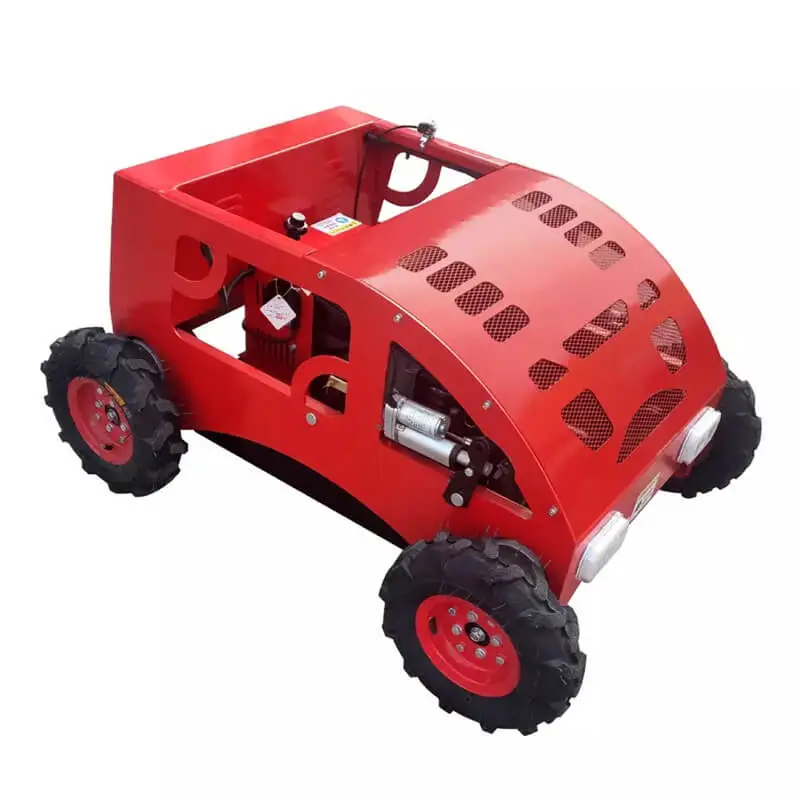
Conclusion First: Mountainous conditions are important suitable application scenarios for remote-controlled lawn mowers. Conventional remote-controlled lawn mowers (mainly tracked, supplemented by wheeled) can achieve efficient application on gentle mountain slopes with a gradient ≤ 30°, while professionally off-road modified tracked remote-controlled lawn mowers can cover moderate to steep mountain slopes with a gradient of 30°~45°. Only steep slopes ≥ 45°, cliff-like mountainous areas and dense vegetation mountainous areas without operation channels are temporarily unsuitable. The core logic is that manual grass cutting in mountainous areas has the pain points of high safety risks and low operation efficiency, while the remote control, terrain adaptability and stable power characteristics of remote-controlled lawn mowers (especially tracked models) can accurately solve the core contradictions of mountain grass cutting, making them an excellent alternative for mountain vegetation pruning. Moreover, tracked and wheeled remote-controlled lawn mowers show clear differences in scene adaptability in mountainous areas.
The Core Pain Points of Mountain Grass Cutting: The Necessity of Applying Remote-Controlled Lawn Mowers
Extremely high manual safety risks
Extremely low operation efficiency and high cost:
Uneven operation effect
Poor mechanical adaptability
Core Requirements of Mountainous Conditions for Remote-Controlled Lawn Mowers: Adaptability Differences Between Tracked and Wheeled Models
General Core Requirements of Mountain Grass Cutting for Remote-Controlled Lawn Mowers
Walking system
Body design
Cutting system
Control and safety
Adaptability Differences Between Tracked and Wheeled Remote-Controlled Lawn Mowers in Mountainous Areas
Comparison Dimension | Tracked Remote-Controlled Lawn Mowers | Wheeled Remote-Controlled Lawn Mowers |
Core Advantages | Large ground contact area, strong grip, low center of gravity, anti-rollover/slipping, good ground-hugging performance, and adaptable to gravel and muddy slopes | Lightweight body, fast driving speed, high operation efficiency, flexible steering, simple maintenance and low cost |
Applicable Gradient | Conventional models ≤ 30°, off-road modified models 30°~45° | Only applicable to gentle mountain slopes and mountain platforms with gradient ≤ 15° |
Applicable Ground | Uneven gravel ground, muddy slopes, forest-floor with fallen leaves, and dense weed areas | Flat hardened ground, gentle slopes with shallow gravel, and mountain orchard platforms |
Core Disadvantages | Slow driving speed, tracks are easy to be entangled by vines, and the later track replacement cost is slightly higher | Weak grip, easy to slip and roll over on steep slopes, tires are easy to be scratched on gravel ground, and easy to get stuck in muddy ground |
Core Mountain Scenarios | Mountain slopes, grass cutting under forests, economic forest slopes, mountain tea gardens, and grass cutting for barren mountain restoration | Gentle mountain platforms, flat areas between orchard rows, mountain farm lawns, and both sides of mountain roads |
Specific Application Scenarios and Adaptation Schemes of Remote-Controlled Lawn Mowers in Mountainous Conditions
Agricultural Economic Forest Mountainous Areas: Core Demand Scenarios, Tracked Models as the Main Force
- Model adaptation: The mainstream choice is tracked remote-controlled lawn mowers (conventional models for gradients ≤ 30°, off-road modified models for 30°~35°), and only wheeled remote-controlled lawn mowers are used as auxiliary operations on orchard platforms and flat areas between rows;
- Operation advantages: The width of the tracked body is 60~80cm, which is suitable for narrow channels between orchard rows. The ground-hugging walking does not damage crop roots. Remote control can operate at the bottom of the slope, avoiding the safety risk of operators going uphill; the daily operation area can reach 4~6 times that of manual labor, with uniform stubble height and much better cleaning effect than manual labor;
- Operation mode: Adopt the “along-row reciprocating cutting” mode, combined with the anti-winding design of the cutting disc, to easily cut tall weeds and vines between rows, and directly crush the weeds into the field to realize organic fertilizer circulation.
Mountain Ecological Greening and Barren Mountain Restoration: Professional Adaptation Scenarios, Mainly Off-Road Modified Tracked Models
- Model adaptation: Uniformly choose off-road modified tracked remote-controlled lawn mowers (equipped with anti-skid track plates, enhanced body protection, and improved cutting disc power), and wheeled lawn mowers are completely unsuitable due to terrain restrictions;
- Operation advantages: The off-road modified track has stronger grip, can walk stably on gravel and muddy slopes, has good body protection, and resists collisions from gravel and branches; remote control can cover moderate to steep slope areas that are difficult for manual access, especially during the forest fire prevention period, it can quickly clean up weed firebreaks and improve forest fire prevention efficiency;
- Operation mode: Adopt the “partitioned cutting” mode, divide the operation area according to the mountain gradient, cut layer by layer from bottom to top, and cooperate with the body tilting power-off device to completely avoid the safety risk of slope operation.
Mountain Tourism and Rural Mountainous Areas: Diversified Scenarios, Combined Adaptation of Tracked and Wheeled Models
- Model adaptation: Adopt the combined scheme of tracked and wheeled models, use tracked remote-controlled lawn mowers for gentle slopes (15°~30°), and wheeled remote-controlled lawn mowers for gentle platforms and scenic lawns;
- Operation advantages: Wheeled lawn mowers have higher operation efficiency on flat lawns, with a daily operation area 30% higher than that of tracked models and lower maintenance costs; tracked models solve the grass cutting demand on gentle slopes on both sides of roads, avoiding the safety risk of manual operation; the combination of the two achieves double guarantee of “efficiency + adaptation”, which fits the diversified needs of mountain tourism.
Mountain Forest Tending: Niche Professional Scenarios, Adapted to Heavy-Duty Tracked Models
- Model adaptation: Choose heavy-duty tracked remote-controlled lawn mowers (equipped with high-power cutting discs and enhanced track wear resistance);
- Operation advantages: The high-power cutting disc can cut relatively thick weed saplings (diameter ≤ 5cm), replacing manual machete operation; the tracked ground-hugging walking does not damage the roots of young forests, and remote control can enter dense young forest areas that are difficult for manual access, improving tending efficiency.
Existing Limitations and Optimization Schemes of Remote-Controlled Lawn Mowers in Mountainous Applications
Core Existing Limitations
- Gradient and terrain limitations: Conventional models can only cover mountainous areas with gradients ≤ 30°. Steep slopes ≥ 45° and cliff-like mountainous areas are temporarily unsuitable due to insufficient grip and high rollover risk; mountainous areas with dense vegetation without operation channels cannot be entered by the body, resulting in operation blind areas.
- Model-specific problems: Tracked lawn mowers are easy to be entangled by mountain vines, leading to walking jams, and track plates wear quickly on gravel slopes; wheeled lawn mowers are easy to slip on gentle slopes with shallow gravel, tires are easy to leak after being scratched, and there is a high risk of rollover on steep slopes.
- Environmental and control interference: Dense trees in mountain forests will block remote control signals (2.4G/Bluetooth), resulting in shortened effective control distance; mountainous areas have many rainy days, the ground is muddy, which is easy to cause body slipping and cutting disc sticking to mud, affecting operation efficiency.
- Battery life and supply limitations: Most mountainous areas are remote and have no external power supply. Conventional remote-controlled lawn mowers have a single battery life of 2~3 hours. Long-time operation requires frequent battery replacement or fuel refueling, affecting operation continuity.
Targeted Optimization Schemes
- Model technology modification: Enhance mountain adaptability by model
- Tracked remote-controlled lawn mowers: Install track anti-winding scrapers to timely clean vines between tracks; replace with wear-resistant and anti-skid alloy track plates to improve wear resistance on gravel slopes; lower the center of gravity of the body and install rollover protection frames to increase the applicable gradient to 45°.
- Wheeled remote-controlled lawn mowers: Replace with wide-surface large-pattern off-road tires to increase grip and prevent slipping on gentle slopes with shallow gravel; installtire anti-scratch protective layers to reduce tire damage; equip with automatic steep slope braking systems to avoid rollover risks on gentle slopes within 15°.
- Control and operation optimization: Adapt to mountain environmental characteristics
- Remote control system upgrade: Replace the conventional 2.4G remote control with an anti-interference 4G/GPS dual-mode remote control to break through the signal blocking of forest trees, increase the effective control distance to 500 meters, and realize GPS positioning at the same time to prevent the equipment from being lost in mountain blind areas.
- Formulation of operation specifications: Mountain grass cutting should follow the principles of “from bottom to top, partitioned operation, and gradient stratification”, and operation on steep slopes ≥ 45° is prohibited; operation should be carried out after the ground is dry in rainy weather to avoid muddy slipping; before operation, clean up large gravel and thick vines in the operation area to prevent entanglement of the cutting disc and collision of the body.
- Battery life and supporting optimization: Ensure continuous mountain operation
- Battery life improvement: Equip electric models with large-capacity backup lithium batteries (supporting fast charging, 1 hour of charging for 2 hours of battery life); increase the fuel tank capacity of fuel models, and equip with portable fuel cans;
- Supporting facilities: Set up temporary supply points in mountain operation areas, equipped with charging equipment, refueling tools, and simple maintenance accessories (track plates, blades, seals) to solve the supply and emergency maintenance problems in remote mountainous areas.
Application Value and Development Trend of Remote-Controlled Lawn Mowers in Mountainous Conditions
Core Application Value
- Safety value: It completely liberates operators from high-risk mountain slope grass cutting operations. Remote control realizes “operators in safe areas and equipment in operation areas”, greatly reducing the incidence of safety accidents in mountain grass cutting and fundamentally solving the safety pain points of mountain grass cutting.
- Efficiency and economic value: The daily operation area of remote-controlled lawn mowers is 4~6 times that of manual labor, which can effectively reduce the labor cost of mountain grass cutting and solve the problems of labor shortage and high labor cost in remote mountainous areas; at the same time, the uniform grass cutting effect can improve the management quality of mountain economic forests and ecological greening, and indirectly increase industrial income.
- Ecological value: Remote-controlled lawn mowers can crush weeds into the field to realize organic fertilizer circulation and reduce the use of chemical fertilizers; in barren mountain restoration and forest fire prevention, they can quickly clean up weed firebreaks, improve forest fire prevention capacity, and protect the mountain ecological environment; in addition, the ground-hugging walking of the body does not damage mountain soil and vegetation roots, which meets the requirements of ecological protection.
Future Development Trend
- Intelligent upgrading: Install laser radar + visual obstacle avoidance systems to realize automatic obstacle avoidance and path planning in mountainous areas, upgrading from “manual remote control” to “semi-automatic operation” to reduce manual control intensity; equip with gradient sensors to realize automatic leveling and further improve the stability of slope operation.
- Professional segmentation: Launch specialized tracked remote-controlled lawn mowers for different mountain scenarios (orchards, tea gardens, barren mountains). For example, the orchard-specific model optimizes the body width and cutting disc height, and the barren mountain-specific model enhances the cutting power and track wear resistance to achieve “scene customization”.
- Multi-functional integration: On the basis of the grass cutting function, add functions such as soil loosening, fertilization and pesticide spraying to realize “one machine for multiple uses” in mountainous areas, improve the utilization rate and cost performance of equipment, and fit the diversified management needs of mountain agriculture.
- Battery life and power upgrading: Develop new energy hybrid models (electric + fuel) of remote-controlled lawn mowers, which take into account the environmental protection of electric power and the long battery life of fuel, solving the problem of battery life supply in remote mountainous areas; upgrade lithium battery technology to improve the battery life stability in high and low temperature environments and adapt to the complex climate of mountainous areas.